We ran 72,000 newsletter subscribers through enrichment
There is no single match rate. Real numbers from resolving 72,878 newsletter subscribers against public evidence — including the 68% we could not identify.

Every media kit says roughly the same thing: "Our readers are decision-makers." Sponsors nod politely and then ask the question that actually matters: can you show me?
We wanted to know what "showing them" looks like in practice. So we took 72,878 real subscribers across seven newsletters and tried to identify who each person is: name, role, company, industry. Not by surveying a few hundred readers and extrapolating. By resolving each email address individually against public evidence.
Here's what happened.
The results
There is no single match rate, and any vendor who quotes you one is averaging away the thing that matters. Here's what we found:
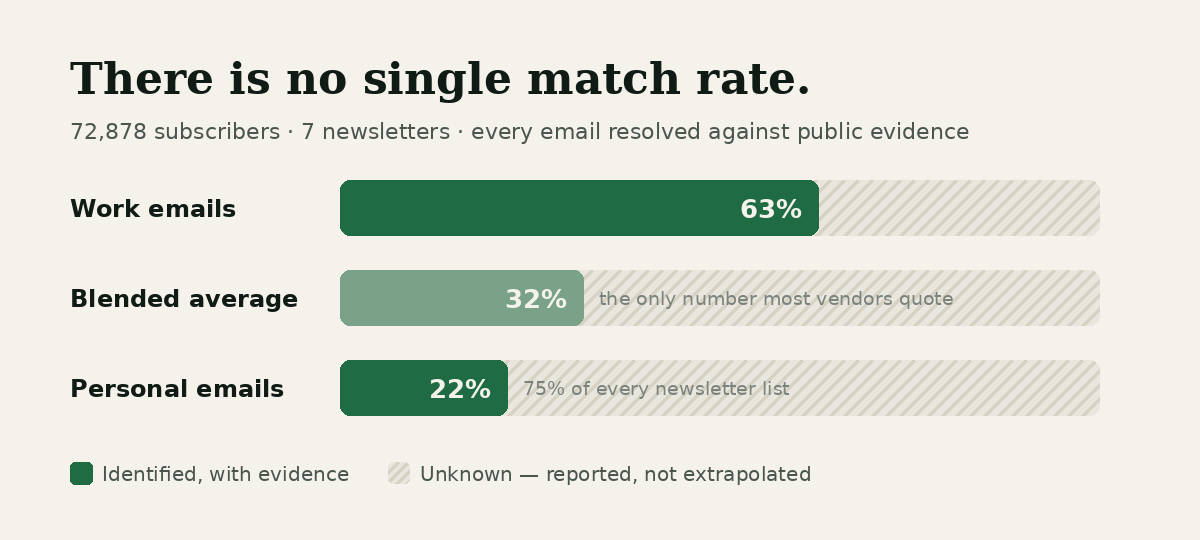
That leaves 68% unknown today. We report it that way on purpose. Unknown means unknown, not "probably similar to the rest."
Why 32% beats 100%
A survey of 300 readers will happily tell you that 100% of respondents have a job title. Then you extrapolate to 70,000 people from the 0.5% who like filling out surveys.
Individually resolved data works the other way. It covers less of the list, but every claim is attached to an actual person with actual evidence. When a sponsor asks "how do you know a fifth of your identified readers are founders?", the answer is "here are the resolved profiles," not "we asked a few people in 2023."
23,000 identified readers with companies and industries is a stronger sales asset than a whole-list guess. It's also more defensible in the meeting where a marketing manager has to justify the spend to their boss.
How we check ourselves
Confidence scores that grade their own homework aren't worth much, so we don't rely on them alone. Every match carries the evidence it was resolved from. Results are scored against a human-reviewed gold set, disposable and dead domains are filtered before they can pollute reports, and we're building toward something no one in this space publishes: a precision audit that compares our enrichment against what readers say about themselves in first-party surveys. When we publish that number, it will include the misses.
The unknowns are a queue, not a ceiling
A licensed contact database decays. People change jobs every couple of years, and a profile appended in 2023 quietly goes stale on someone's media kit.
Evidence-based resolution moves in the opposite direction, for two reasons:
What sponsors do with it
The identified segment changes the conversation.
The takeaway for publishers
You don't need to identify everyone. You need to identify enough readers, with evidence, to prove the pattern, and then be honest about the remainder.
Most subscriber lists are treated as email addresses. They're actually the most underused sales asset a publisher owns. The publishers who figure this out first will price differently, sell faster, and keep sponsors longer.
Reach got you the meeting. Proof closes it.
We're building this at audience.is — happy to run a sample report on your list.